
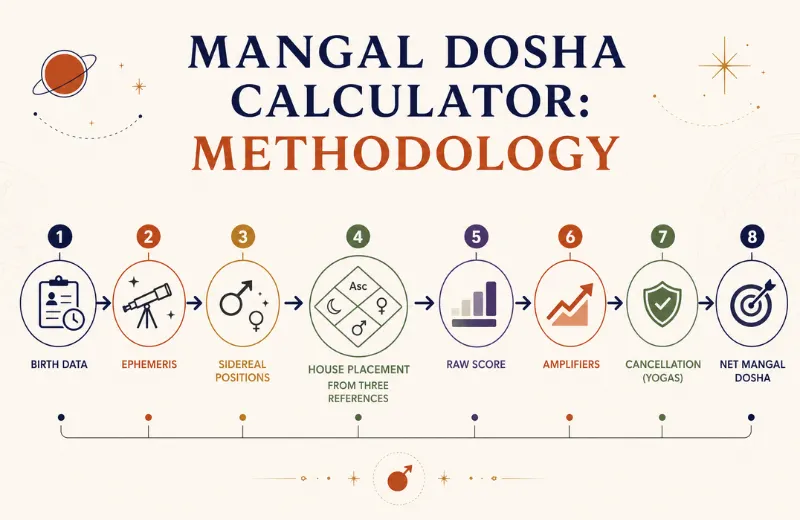
Mangal Dosha Pro calculates every chart in three separate layers — real astronomical positions from published methods, classical Vedic rules tied to named sources, and a proprietary scoring system labelled clearly as our own addition — and this page documents exactly how, so the calculation can be checked rather than taken on faith.
What are the three layers, and why are they kept separate?
Layer 1 is astronomy: where Mars, the Moon, the Ascendant, and the other points actually were at birth, checkable math rather than opinion. Layer 2 is classical rules: whether classical astrology says a placement forms Mangal Dosha, and whether any of the ten Dosha Bhanga cancellation conditions apply, each tied to a named tradition. Layer 3 is our scoring: the Mangal Impact Index™, built to compare severity across charts, explicitly labelled as our addition and never presented as classical doctrine.
How is Layer 1, the astronomical engine, calculated?
Positions are calculated using the solar and lunar position methods described in Jean Meeus’s Astronomical Algorithms, Keplerian orbital elements for the other planets, and a mean-node calculation for Rahu and Ketu, run on our own server rather than a third-party API, so the same input always produces the same, checkable output.
Why is the Lahiri ayanamsa used instead of another?
Because it is the official Indian standard, which makes our results comparable to what a family astrologer would say.
The Lahiri (Chitrapaksha) ayanamsa was adopted by India’s Calendar Reform Committee in the 1950s, under the physicist Meghnad Saha. It anchors the sidereal zodiac to the star Chitra (Spica) at exactly 0° Libra.
Comparability is the practical argument. Lahiri is the ayanamsa behind India’s official Panchang and the large majority of mainstream Vedic astrology software. Choosing Raman or KP instead would produce defensible results that disagreed with almost every other source a user is likely to consult — which is a poor trade for a site whose purpose is to reduce confusion.
Why are whole-sign houses used instead of Placidus?
Because whole-sign houses are the system classical Vedic texts actually use.
In whole-sign, the sign containing the Ascendant becomes the entire 1st house, the next sign the 2nd, and so on — house and sign are the same unit. Quadrant systems such as Placidus divide houses by time instead, which produces different house boundaries and is not the traditional basis for Vedic dosha analysis. Using Placidus here would mean calculating a classical rule with a non-classical house system.
How does timezone handling affect accuracy?
Timezone handling affects accuracy significantly, since a large share of “wrong result” complaints on rival sites trace back to incorrect timezone data — a roughly 160-city database on fixed IST for India, plus manual latitude/longitude/UTC-offset entry elsewhere, with Daylight Saving Time noted where it applies, addresses this directly; an incorrect timezone can shift the Ascendant into a different sign entirely.
Where does accuracy actually matter for a Mangal Dosha result?
For which sign a planet falls in — not its exact degree.
Mangal Dosha depends entirely on sign placement, and positions here are accurate to within a few arc-minutes for any birth year from 1800 to 2049. That is far more precision than sign placement requires, which is why we do not make much of the decimal places.
There is one exception, and it is the case worth flagging. When the Ascendant or Mars sits within about 0.75° of a sign boundary, a small birth-time error can flip the result outright. Those charts are flagged directly in the result rather than presented with false confidence.
How does Layer 2 detect and cancel Mangal Dosha?
Detection checks Mars’s house position from the Lagna, Chandra Lagna, and Shukra Lagna using whole-sign houses, with the 1st, 4th, 7th, 8th, and 12th houses cited most consistently across classical sources and the 2nd house included by South Indian tradition specifically. The full cancellation logic is documented in the ten cancellation rules, with cancellation strength capped at 85% since classical tradition treats a dosha as mitigated, not erased.
How does Layer 3, the Mangal Impact Index™, work?
The Mangal Impact Index™ weighs which reference point triggered (Lagna, Moon, or Venus), which house it fell in, and any amplifying factors like Saturn’s involvement, then reduces that raw number by cancellation strength to produce a net 0–100 score, with the full point-by-point math shown in every result rather than hidden.
How is the birth-time confidence figure calculated?
The birth-time confidence figure is measured, not estimated: the engine recalculates your Ascendant at successive offsets either side of the recorded time and reports the exact point at which the Ascendant sign — and with it the whole-sign house of Mars from the Lagna — changes.
That distinction matters because the Ascendant does not move at a uniform rate. A common shortcut treats it as one sign every two hours, or one degree every four minutes. The true figure depends on your latitude and on which sign is rising, and the spread is wide:
| Birth latitude | Fastest sign to rise | Slowest sign to rise |
|---|---|---|
| Kanyakumari, 8.5°N | Aries, 104 min | Cancer and Sagittarius, 131 min |
| Chennai, 13.1°N | Aries, 100 min | Cancer and Sagittarius, 132 min |
| Mumbai, 19.1°N | Aries and Pisces, 95 min | Cancer, 134 min |
| Delhi, 28.6°N | Aries and Pisces, 86 min | Scorpio, 141 min |
| Srinagar, 34.1°N | Aries and Pisces, 80 min | Leo and Scorpio, 145 min |
A flat two-hour assumption therefore overstates the safe window by up to a third for a north Indian birth in a short-ascension sign — in the direction that makes a result look more reliable than it is. We measure it per chart instead.
The reported window is also asymmetric. Because you may sit near one sign boundary and far from the other, a chart can be stable for 115 minutes earlier and only 6 minutes later than the recorded time. Both figures are shown separately rather than collapsed into a single average.
What is deliberately not corrected for?
Two approximations are left in place because they are far smaller than the tolerance the method needs, and naming them is more useful than implying a precision we don’t have.
The first is the difference between Universal Time and Terrestrial Time. The planetary and lunar formulas expect Terrestrial Time; we feed them Universal Time. The gap is currently about 70 seconds, which displaces the Moon by roughly 0.01° and the planets by far less — about one seventy-fifth of the 0.75° cusp threshold at which we already flag a chart for verification. The Ascendant is unaffected, since it derives from sidereal time, which is defined from Universal Time.
The second is light-time and nutation, both under 0.01° for the bodies used here.
Neither can change a whole-sign house placement except in a chart already inside the cusp warning band, where the advice is to verify the birth time regardless. See the glossary for definitions of the terms used on this page.
Why can two cancellation rules count as only one?
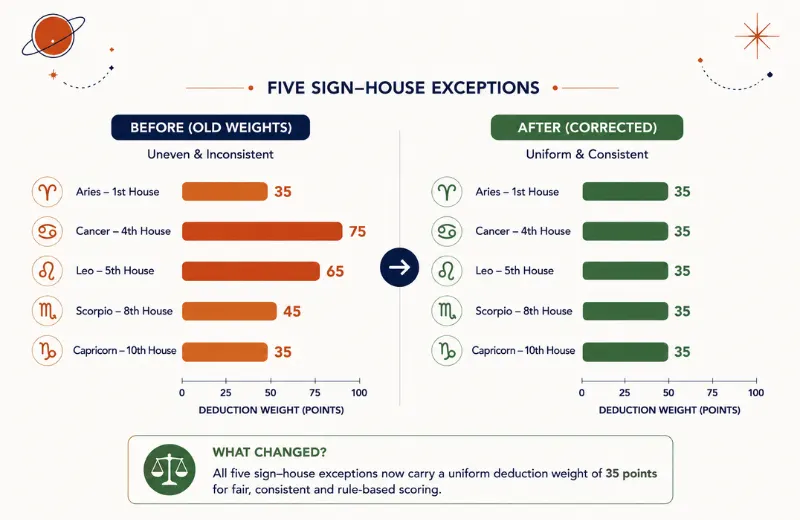
Two rules count once when they describe the same placement rather than two independent facts about the chart. The five classical sign-and-house exceptions — Mars in Aries in the 1st, Scorpio in the 4th, Capricorn in the 7th, Cancer in the 8th, Sagittarius in the 12th — each carry a weight of 35. Where another rule in the list restates that same placement, we count the exception once at full weight instead of stacking the restatement on top.
Two kinds of restatement occur, and both are now absorbed.
A dignity already named by the exception. Four of the five combinations describe a dignity that the dignity rules score separately: Aries in the 1st and Scorpio in the 4th are Mars in its own sign, Capricorn in the 7th is Mars exalted, Cancer in the 8th is Mars debilitated. Counting the exception and the dignity together scored one classical fact twice.
An ascendant the exception has already fixed. A sign-and-house pair determines which ascendant you can have. Scorpio can only occupy the 4th house from a Leo ascendant, and Capricorn can only occupy the 7th from a Cancer ascendant — and those are precisely the two ascendants for which Mars is Yogakaraka. The Yogakaraka rule therefore fired on those two combinations every single time and on the other three never, which is a property of the geometry rather than an observation about any individual chart.
Left uncorrected, that second overlap produced this:
| Combination | Ascendant it forces | Weight before | Weight now |
|---|---|---|---|
| Mars in Aries, 1st house | Aries | 35 | 35 |
| Mars in Scorpio, 4th house | Leo | 75 | 35 |
| Mars in Capricorn, 7th house | Cancer | 65 | 35 |
| Mars in Cancer, 8th house | Sagittarius | 45 | 35 |
| Mars in Sagittarius, 12th house | Capricorn | 35 | 35 |
The classical verses weight the five exceptions equally. Our arithmetic now does too. Where a rule has been absorbed, the report names it explicitly and shows it as present-but-already-counted rather than as absent — the condition is genuinely in your chart, and a Cancer or Leo ascendant reading a report that called Yogakaraka “not present” would be right to distrust it.
The Navamsa rule is not absorbed, because it is genuinely independent. The D9 position of Mars varies with the degree Mars occupies, so two people with Mars in Scorpio in the 4th house can have different Navamsa signs and correctly receive different scores. It describes a second chart, not the same placement under another name.
Which classical factors does this method not use?
Four strength factors found in classical practice are deliberately not scored here, and the reason is the same in each case: they modify how strongly Mars expresses, not whether the dosha is detected or cancelled, and no classical source we work from assigns them a defined role in Dosha Bhanga.
| Factor | What it is | Why it is excluded |
|---|---|---|
| Combustion (Asta) | Mars within roughly 17° of the Sun, traditionally weakened | Weakening is not cancellation in the Dosha Bhanga lists; folding it in would be our inference, not a classical rule |
| Retrogradation (Vakri) | Mars in apparent backward motion | Sources disagree sharply on whether retrograde planets gain or lose strength |
| Vargottama | Mars in the same sign in the D1 and D9 charts | A general strength marker, not a marriage-specific cancellation |
| Shadbala | The six-fold numerical strength system | A whole parallel framework; mixing its output into a dosha score would blur two different methods |
Naming these matters more than quietly omitting them. A calculator that silently drops factors and a calculator that never considered them look identical from the outside, and the difference is exactly what a reader is entitled to check.
Would including these factors change many results?
Combustion is the one most likely to matter, since Mars is within 17° of the Sun reasonably often. The others are rarer or more marginal. We exclude all four because none carries a defined role in the Dosha Bhanga lists, and adding them would mean scoring conditions the sources do not name.
What limitations does this methodology have?
This method has four limitations worth stating plainly.
- Birth-time sensitivity near a sign boundary. A chart within 0.75° of a cusp is flagged in every result, because a small time error can move Mars or the Ascendant into a different sign and change the reading.
- The 2nd house is contested. Its inclusion is a genuine, longstanding disagreement between traditions, not an error in either direction.
- This is interpretation, not prediction. Nothing here forecasts a specific event in a specific life.
- Other calculators will disagree with us. The three specific causes are set out in why calculators differ.
The question of whether any of this is real is separate from whether it is calculated correctly, and is treated on its own page: whether Mangal Dosha is real separates what is astronomically verifiable from what is traditional interpretation.
How should these limitations change how you read a result?
Treat the severity band as the finding and the exact number as a summary of it. A score of 48 and a score of 52 sit either side of a band boundary but describe near-identical charts, and no part of this method is precise enough to make that difference meaningful.
Frequently asked questions
Does a small birth-time error change my Mangal Dosha result? Usually not — it matters most when the Ascendant or Mars sits close to a sign boundary, which is flagged in every result.
Why is the 2nd house included when some sites don’t? Because a large, well-established branch of practice, particularly South Indian tradition, includes it, shown with the reasoning attached.
Is the Mangal Impact Index a classical measurement? No — it’s a proprietary scoring framework built on classical detection and cancellation findings, labelled explicitly so it’s never mistaken for scripture.
Can a Mangal Dosha ever be reduced to zero? Not in this engine — cancellation caps at 85% mitigation, reflecting the classical view that the placement itself doesn’t disappear.
Which ephemeris does this use? A purpose-built implementation using Meeus algorithms with JPL Keplerian elements, validated against reference values. No external API is called.
Is your ephemeris accurate enough? Positions are accurate to a fraction of a degree across 1800-2049, which is far more precision than sign placement requires.
Which ayanamsa and house system? Lahiri ayanamsa(Chitrapaksha) and whole-sign houses, both stated here rather than left implicit, since either choice changes results near boundaries.
Do you use whole-sign or Placidus houses? Whole sign, which is the classical standard for this tradition and the system the cancellation rules assume.
Where do your cancellation weights come from? They are our own scoring layer built on classical rules. The rules are sourced and named; the numeric weights are ours and are labelled as such.
Who is responsible for this methodology?
The astrological content and the sourcing decisions above are the responsibility of Jyothish Nambiar, reviewed by Maneesh Narayanan. The author page lists the classical sources this method draws on and states plainly what the site does not claim.
Where to go next
Our methodology documents the calculation in full — ephemeris, ayanamsa, house system, the ten rules and the scoring decisions that are ours rather than classical. Why calculators disagree explains why another site may disagree with us, and what the evidence supports separates what is astronomically verifiable here from what is traditional interpretation. Calculating without a birth time covers how birth-time tolerance is measured per chart.