
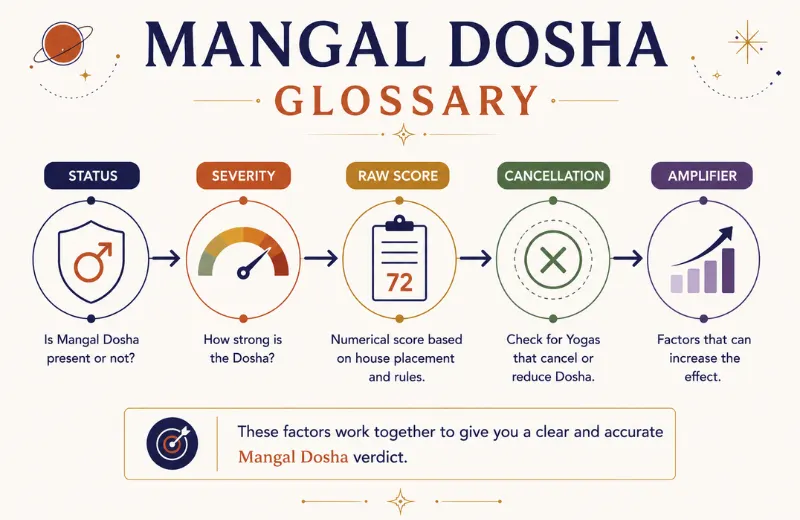
This glossary defines the 20 terms used across this site, from the free calculator result to the full report, covering the three reference points, the chart divisions, the cancellation doctrine, the remedies, and the two scores that are ours rather than classical.
What does Mangal Dosha mean, and what other names does it go by?
Mangal Dosha is Mars occupying particular houses in a birth chart. Mangal Dosha — also called Manglik Dosha, Kuja Dosha, Bhauma Dosha, or Angaraka Dosha — is the condition where Mars occupies specific houses in a birth chart, traditionally read as creating friction or delay in marriage and domestic life; “Mangal/Manglik” is most common in North India, “Kuja Dosha” in South Indian usage. → What Is Mangal Dosha?
What is Kuja Dosha?
Kuja Dosha is the South Indian name for the condition above, somewhat more likely to include the 2nd house among the trigger houses, following regional texts such as Deva Karalam. → Kuja Dosha
What is Dosha Bhanga?
Dosha Bhanga is the classical concept of dosha cancellation — specific chart conditions under which a dosha, once formed, is weakened or neutralized. → the ten cancellation rules
How many Dosha Bhanga rules does this site use?
Ten, each with a named classical source and a weight between 10 and 35 points. The full set is listed on the cancellation rules page, and each has its own detailed page.
What is Anshik Manglik?
Anshik Manglik (Partial Manglik) is a chart where Mars triggers the dosha from only one of the three reference points rather than two or three, generally treated as milder than full Manglik status. → Anshik Manglik Explained
What is the Lagna?
The Lagna (Ascendant) is the zodiac sign rising on the eastern horizon at the exact moment and place of birth, the most personal reference point in a chart and the first of the three positions checked for Mangal Dosha.
Why does the Lagna carry the most weight?
Because it is the most personal point in the chart — it depends on the exact moment and place of birth rather than on a slower-moving planet. Our scoring weights it at 50%, against 30% for the Moon and 20% for Venus.
What is the Chandra Lagna?
The Chandra Lagna (Moon Ascendant) is the Moon’s sign, treated as a second “ascendant” for house counting, checked because the Moon represents the mind and emotional life.
What is the Shukra Lagna?
The Shukra Lagna (Venus Ascendant) is Venus’s sign, used the same way as the Chandra Lagna, checked because Venus governs relationships and marriage specifically.
What are whole-sign houses?
Whole-sign houses (Rasi) are the house system used throughout classical Vedic astrology, where the sign containing the Ascendant becomes the entire 1st house and so on, unlike Western quadrant systems such as Placidus. → our methodology
What is the Lahiri ayanamsa?
The Lahiri Ayanamsa (Chitrapaksha) is the offset value used to convert the Western tropical zodiac to the Vedic sidereal zodiac, anchored to the star Chitra (Spica) at exactly 0° Libra, adopted by India’s Calendar Reform Committee in the 1950s. → our methodology
What is Yogakaraka?
Yogakaraka is a planet that, for a specific Ascendant, rules both an angular house and a trine house, making it a “functional benefic” regardless of its usual nature — Mars becomes Yogakaraka for Cancer and Leo Ascendants specifically.
What is the Navamsa (D9)?
The Navamsa is the divisional chart that splits each zodiac sign into nine equal parts of 3°20′ each, used to judge a planet’s deeper strength and, specifically, marriage-related matters. → Mars in the Navamsa
What is a Nakshatra?
A Nakshatra is one of 27 lunar mansions the zodiac is divided into, each roughly 13°20′ wide, with its own ruling planet; Mars rules three: Mrigashira, Chitra, and Dhanishta. → Mars and the Nakshatras
What is Vimshottari Dasha?
Vimshottari Dasha is the most widely used planetary period system in Vedic astrology, dividing a life into planet-ruled periods based on the Moon’s nakshatra at birth; Mars governs a period of roughly seven years within it. → Mars and the Nakshatras
What is Papa Samya?
Papa Samya is a classical concept comparing the combined malefic load (typically Mars, Saturn, and Rahu) between two charts, used to judge whether that load is balanced between partners. → Compatibility Calculator
What is Gun Milan (Ashtakoota Matching)?
Gun Milan is a broader 36-point compatibility system used in Vedic marriage matching, covering many factors beyond Mangal Dosha alone; our Mangal Dosha–specific check is related but narrower, not a substitute for a full Gun Milan analysis. → Compatibility Calculator
What is Mangal Shanti?
Mangal Shanti is a general term for peace-inducing rituals aimed at pacifying or balancing Mars’s more difficult significations, encompassing mantra, temple pooja, and related devotional practices. → Mangal Dosha Remedies
What is Kumbh Vivah?
Kumbh Vivah is a symbolic pre-marriage ceremony in which a person is “married” to an object, traditionally performed for more severe Mangal Dosha readings tied to the 8th house. → Kumbh Vivah Explained
What is Red Coral (Moonga)?
Red Coral is the gemstone classically associated with strengthening Mars, traditionally appropriate only for a chart where Mars is genuinely weak. → Red Coral Guide
What is the Mangal Impact Index™?
The Mangal Impact Index™ is a proprietary 0–100 severity scoring framework built on classical detection and cancellation findings, labeled clearly as a site-specific addition rather than a classical measurement. → our methodology
What is the Functional Mars Index?
The Functional Mars Index is the classification used in detailed reports to read a chart’s Mars as Constructive, Mixed, or Troublesome, determining whether strengthening or pacifying Mars is actually appropriate. → How to Make Mars Strong
Frequently asked questions
What is the difference between Manglik and Mangal Dosha? None. Manglik describes a person carrying Mangal Dosha.
What does Anshik mean? Partial. It describes a dosha triggering from one or two of the three reference points rather than all three.
What is a Navamsa? The D9 divisional chart, which classical practice weights heavily for marriage questions. See Mars in the Navamsa.
What does Dosha Bhanga mean? Cancellation of the dosha — the classical category covering the conditions under which it does not apply at full force.
What is an ayanamsa? The offset between the tropical and sidereal zodiacs. This site uses Lahiri, the Indian government standard.
What is a Yogakaraka? A planet ruling both an angle and a trine from the ascendant, making it the chart’s most beneficial planet. Mars qualifies for Cancer and Leo ascendants only.
What is the difference between status and severity? Status counts how many of the three reference points trigger — Manglik, Partial, or Non-Manglik. Severity weighs which houses are involved and applies cancellation. They can disagree, and the severity figure carries more information.
What does Dosha Bhanga mean? The classical term for cancellation — the conditions under which a dosha is held not to apply at full force. Our ten rules implement it.
What is an amplifier? A factor that increases the raw score before cancellation, such as a Saturn aspect or a Rahu conjunction with Mars. Amplifiers never create a dosha on their own.
Where to go next
Our methodology documents the calculation in full — ephemeris, ayanamsa, house system, the ten rules and the scoring decisions that are ours rather than classical. why calculators disagree explains why another site may disagree with us, and what the evidence supports separates what is astronomically verifiable here from what is traditional interpretation. Every term here links to the page that covers it in depth.
Written by Jyothish Nambiar · Reviewed by Maneesh Narayanan · Published on 14th August 2026 · Last updated August 2026.