
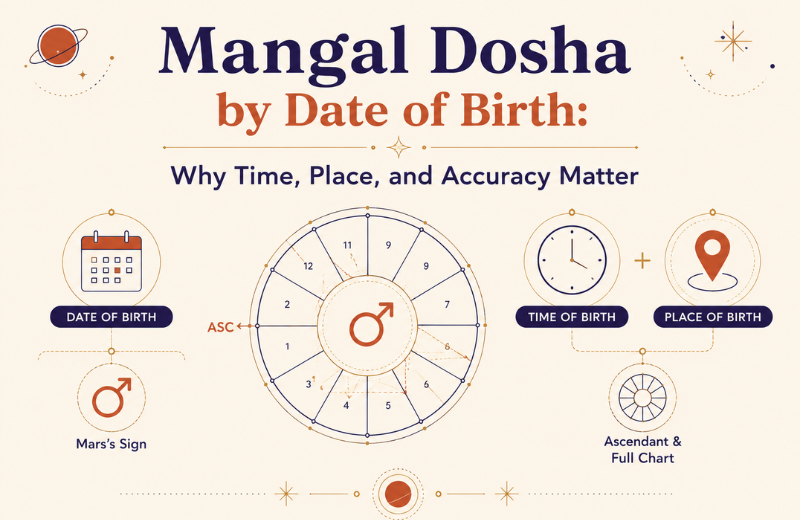
Mangal Dosha by date of birth requires more than the date alone — birth time and place are both needed, because the Ascendant, the most important reference point in the analysis, shifts one zodiac sign every 80 to 145 minutes, depending on latitude and which sign is rising and changes with location too.
Mangal Dosha Calculator by DOB
Mangal Dosha Calculator — By Date of Birth
Check Mangal Dosha by date of birth, time and place. All three are genuinely required: the Ascendant changes sign roughly every two hours, and the Moon changes sign every two and a half days — so the same date can be Manglik at 9 AM and Non-Manglik at noon. This calculator computes your exact sidereal chart from your birth details and evaluates Mars from Lagna, Moon and Venus with a complete cancellation check.
Why isn’t date of birth alone enough?
Date of birth alone isn’t enough because Mangal Dosha depends on which house Mars occupies from three reference points — the Lagna, Chandra Lagna, and Shukra Lagna — and houses are anchored to the Ascendant, one of the fastest-moving points in the chart.
How much does birth time actually change the result?
Enough to change the answer, once the gap reaches an hour or more.
The Ascendant moves through one sign in as little as 80 minutes or as much as 145, depending on latitude and which sign is rising. Two people born on the same day, in the same city, a few hours apart, can therefore have different Ascendants — and a different Mangal Dosha result — even with Mars in the identical sign for both.
That is the whole reason date alone is not enough. Mars’s sign barely moves in a day; the Ascendant moves through every sign in the zodiac.
Why does place of birth matter too?
Because the Ascendant depends on your location as well as the moment. Place of birth matters because the Ascendant is calculated from local sidereal time, which depends on longitude — two people born at the same clock time in different cities (Mumbai versus Kolkata, for example) have different Ascendants, since the sky looks different from each location at that same moment. Timezone handling compounds this: an incorrect UTC offset shifts the calculation as if the birth happened at a different time entirely.
What do I need to provide, and why?
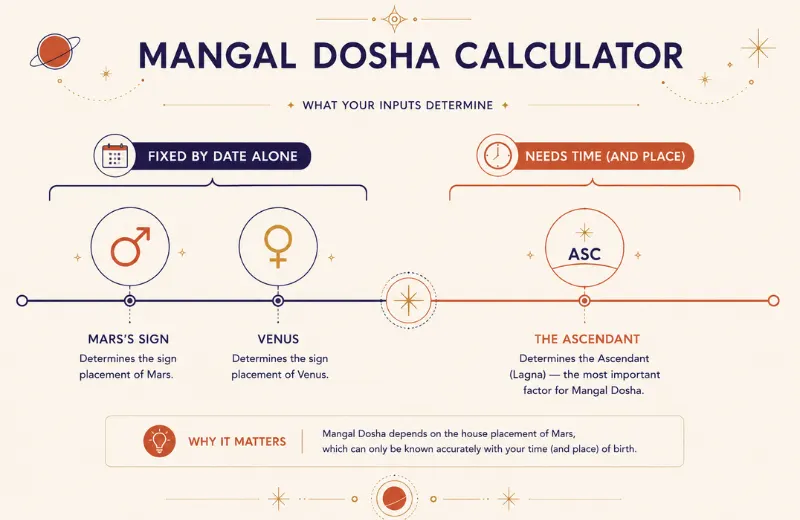
Three things: date, time and place of birth. Three inputs are needed: date of birth (establishes general planetary positions), time of birth (pins down the Ascendant, Moon position, and house cusps — the single most sensitive input), and place of birth (anchors the calculation to the local sky, correcting for longitude and historical timezone rules).
What if I do not know my birth time?
You can still get a partial reading from the Moon and Venus references, covering 50% of the weighting — but the Ascendant at 50% is lost, and with it rules 8 and 9. Mangal Dosha without birth time covers what that reading can and cannot establish.
What if I don’t know my exact birth time?
The calculator has an “I don’t know my exact birth time” option that runs on a noon convention.
What matters is what it does next: it flags every place the result could shift with a more precise time, rather than presenting a noon-based answer as though it were certain. The flag matters most when the Ascendant or Mars sits close to a sign boundary, where a gap of 15 to 30 minutes can change the outcome. Full detail on how that sensitivity is measured is on our methodology page.
How much of the score survives without one?
Half. Venus is fully reliable without a birth time and the Moon usually is, together carrying 50% of the score. The Ascendant — the other 50%, plus the two house-gated cancellation rules — cannot be calculated without one. Mangal Dosha without a birth time sets out how to test an uncertain time across a range, and why a 12 noon default is worse than no answer at all.
What if the birth details are incomplete?
Mangal Dosha without birth time covers exactly what can still be calculated when the time is unknown, and why a partial reading can confirm a dosha but never rule one out.
Our methodology documents the birth-time tolerance reported with every result.
Frequently asked questions
Can I check my Mangal Dosha with just my date of birth? Not accurately — date of birth alone can suggest Mars’s general position, but the house-based analysis Mangal Dosha depends on requires birth time and place too.
How much does an hour’s difference in birth time matter? It can matter significantly, since the Ascendant moves one sign every 80 to 145 minutes depending on latitude and rising sign, especially near a sign boundary.
What if my birth certificate doesn’t list an exact time? The “I don’t know my exact birth time” option calculates an estimated result and flags exactly where more precision could change the outcome.
Can Mangal Dosha be found from a date alone? Partially. Mars stays in one sign for about 45 days, so its sign is usually certain from the date. What the date cannot give you is the Ascendant, which carries 50% of the score. What works without a birth time sets out the limits.
Why do I need a birth place as well? Because the Ascendant depends on latitude and longitude as well as time. The same moment produces a different rising sign in Kozhikode and in Delhi.
Is a rectified birth time as good as a recorded one? No. Rectification estimates a time from life events and carries its own uncertainty. Treat a rectified result as an estimate, not a recovered fact.
How precise does the birth time need to be? Precise enough to place the Ascendant in the right sign, which changes every 80 to 145 minutes. Every result reports the tolerance for your specific chart.
Does the calculator flag a borderline birth time? Yes. Charts within 0.75° of a sign boundary are flagged explicitly, since a small time error would change the reading.
Where to go next
If you have not run your chart yet, the free calculator gives the status, the severity band and the reasoning behind every point. From there, the ten cancellation rules covers everything that can reduce the figure, the six trigger houses explains why some placements weigh far more than others, and our methodology documents how the whole calculation is derived. If your birth time is unknown or approximate, calculating without a birth time sets out exactly what can still be calculated.
Written by Jyothish Nambiar · Reviewed by Maneesh Narayanan · Published on 14th August 2026; Last updated on 14th August 2026